Asset Register Health Check · For Australian Councils

Find the ghosts in your asset register.

Assets on the books that no longer exist. Valuations nobody has touched in years. Records that won't survive an audit. Our diagnostic reads the exports you already have and hands you a board-ready report — in days, not months.

Works alongside the systems you already runTechnologyOne, Infor Hansen, Civica and the rest — AIP reads their exports. It doesn't replace your asset register, finance system or ERP.
Read-only, by designWe read the exports you already produce and never write back to your systems.
No migration, no integration projectNothing installed, no access to your live environment required.
4 data sourcesfinance, GIS, valuations and condition — cross-checked against each other, not read in isolation
Every finding explainedthe signals, the counter-signals and the source records checked — no black-box scores
Minutes, not monthsfrom the CSV exports you already have to a fully scored register

How it works

Three steps. No project team required.

The Health Check runs on the exports your systems already produce. Nothing is installed, nothing is migrated, nothing writes back.

1

Send your exports

Asset register, finance extract, valuations, condition data, GIS — CSV, Excel or PDF, exactly as your systems produce them today.

2

The engine cross-checks

Every asset is tested against your rules across four lenses — finance, spatial, valuation and condition. Ghosts, stale values, logic breaks and duplicates surface with evidence.

3

Receive the report

A board-ready Health Report: overall verdict, every finding explained, dollar exposure quantified, and a prioritised list of what to fix first.

What you get

Clear benefits, in plain English.

Find ghosts before your auditor does

Assets still on the books that no longer exist in the field — surfaced with the finance and spatial evidence that proves it, before it becomes an audit finding.

Every dollar of exposure quantified

Findings aren't just counted — they carry the register value at stake, so the CFO sees exactly what a "data quality issue" is worth.

Evidence behind every finding

No black-box scores. Each finding shows which signals fired, which counter-signals didn't, and which source records were checked.

Works with what you already have

Reads the CSV, Excel and PDF exports your existing systems produce. No integration project, no vendor lock-in, read-only by design.

Days, not months

A conventional register cleanse is a consultant engagement measured in months. The engine does the reading in minutes; you get the report in days.

A fix-first list, not a data dump

The report closes with priorities: the findings worth acting on first, ranked by dollar exposure and audit risk — not 200 pages of raw exceptions.

Where the money hides

A wrong register isn't a data problem. It's a spending problem.

Every drifted record has a cost attached — a premium, a service contract, a depreciation line, or an uncovered loss. Here's where it leaks, and the finding that exposes each one.

Insurance premiums on assets nobody has touched

The Health Check imports your insurance schedule and matches each policy to a register asset — and separately flags assets gone dormant, with no recorded activity for years. An insured asset that's shown no sign of life is a premium worth a hard second look, and both halves are in the one report to line up.

Insurance match + dormant rule

Money on the books with nothing to reconcile it

Finance records with no matching asset in the register — value carried on the books that isn't tied to anything the register can confirm. Each ghost finding shows the dollar figure behind it, so the unreconciled amount is out in the open, ready to explain or write off.

Ghost detection · dollar exposure

Assets quietly rotting toward an unbudgeted replacement

An asset with no recorded activity for years, or a condition assessment long overdue, is a failure waiting to happen — and a capital bill nobody planned for. The report lists exactly which assets have gone quiet, before they fail on their own schedule.

Dormant + condition-staleness rules

Wrong cover from stale valuations

An asset last valued years ago is either over-insured — premium you don't need — or under-insured, leaving the council exposed on the day of a loss. Valuation-recency findings surface every asset whose value is too old to trust.

Valuation-recency rule

Where a finding can be priced, it carries the register value at stake — computed on your assets, not an industry average. No "councils typically lose 3–5%". That's the number you take to the finance committee.

Rules & audit trail

Built to survive scrutiny — because that's the whole point.

A register diagnostic is worthless if the diagnostic itself can't be defended. Every mechanism below exists so your auditor can trace any number in the report back to source.

Your rules, not ours

Detection rules are data, not code — defined per council, in your language, against your policies. Adjust a threshold or author a new rule without waiting on a vendor release.

Versioned rule lifecycle

Rules move Draft → Production → Historical. A draft can be tested against your real data — with a preview of exactly what it would flag — before it ever affects a report.

"Why was this flagged?" on every finding

Signals, counter-signals and the source records checked — shown for each finding, in the app and in the report. Explainable rule-based scoring, not an opaque AI verdict.

Honest closure — findings can't be gamed

A finding closes only when re-checked data shows it fixed at source. A dismissal is recorded as a dismissal — it is never relabelled "resolved". The report can't flatter itself.

Tamper-evident reports, full audit trail

Every report is hashed and timestamped — traceable to the exact rules and data behind it, and reproducible on demand, so a figure can always be proven back to source. What-if simulations are always watermarked as simulations. Every action — rule change, suppression, import — is logged with who, when and why.

Your data stays yours, in Australia

Australian-hosted, with complete isolation between organisations at every layer — database, search and file storage. Your register never trains anyone else's model.

From the product — Why was this flagged?

Likely ghost asset

Playground equipment · PARK-0417 · Riverside Community Hall reserve

Not found in finance extractsignal fired
No maintenance activity, 4+ yearssignal fired
No GIS geometry at recorded locationsignal fired
Recent condition assessmentcounter-signal — none
Flagged: high confidence · $84,200 at stake

Sources checked: asset register · finance extract · GIS layer · maintenance history. Demonstration data.

What makes it different

Not another asset system. Not another consultant.

The Health Check occupies a gap: faster and cheaper than a consulting engagement, deeper and more defensible than a spreadsheet review, and zero-disruption compared to replacing your systems.

You buy a report, not software

The first engagement is a bounded diagnostic with a concrete deliverable — no licences, no implementation, no change management. Decide about the platform after you've seen what it finds.

vs. asset systems: 12–18 month replacements that migrate the bad data along with the good.

Four lenses on every asset

Finance, spatial, valuation and condition data are cross-checked against each other. A ghost hides easily in one dataset — far less easily across four.

vs. spreadsheet reviews: one dataset, one pair of eyes, no cross-checking.

Explainable by construction

AI does the reading — classifying files, matching records, normalising units. The judgment stays in transparent, versioned rules you control. Every verdict is traceable; nothing is "the model said so".

vs. black-box AI tools: impressive demos, indefensible in front of an audit committee.

Repeatable, not a one-off cleanse

A consultant's cleanse decays from the day the report lands. The engine re-runs on every new import — findings close when data is fixed at source, and drift is caught as it happens.

vs. consulting engagements: point-in-time, six figures, and stale within a year.

The product

What your team sees.

The platform behind the diagnostic — the same engine, live, for councils that continue past the first report.

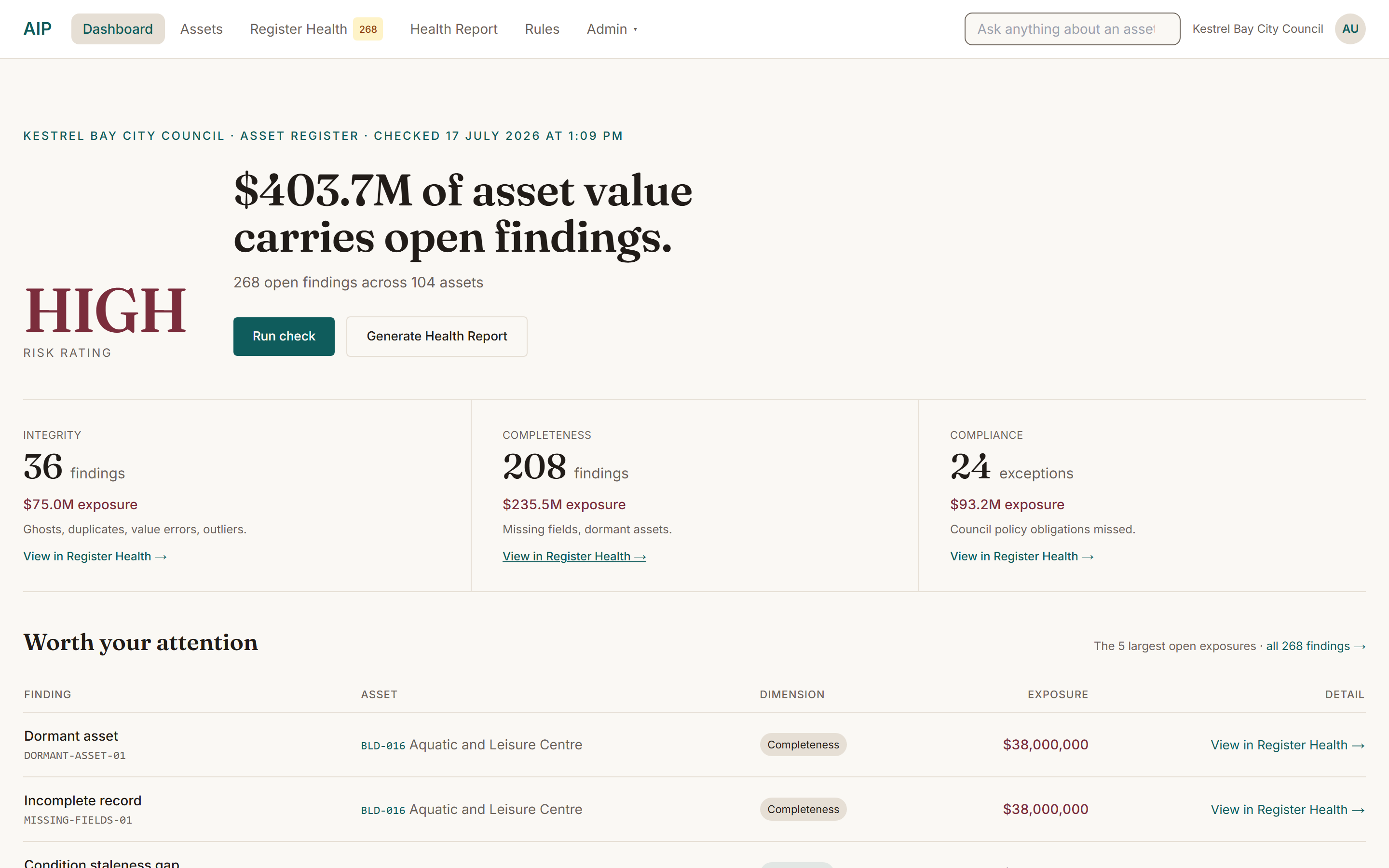
Asset Intelligence Platform dashboard showing the register health verdict: $403.7M of asset value carries open findings, HIGH risk rating, with integrity, completeness and compliance breakdowns
The verdict, up front: overall register health, dollar exposure, and the largest open findings — one screen, no digging.
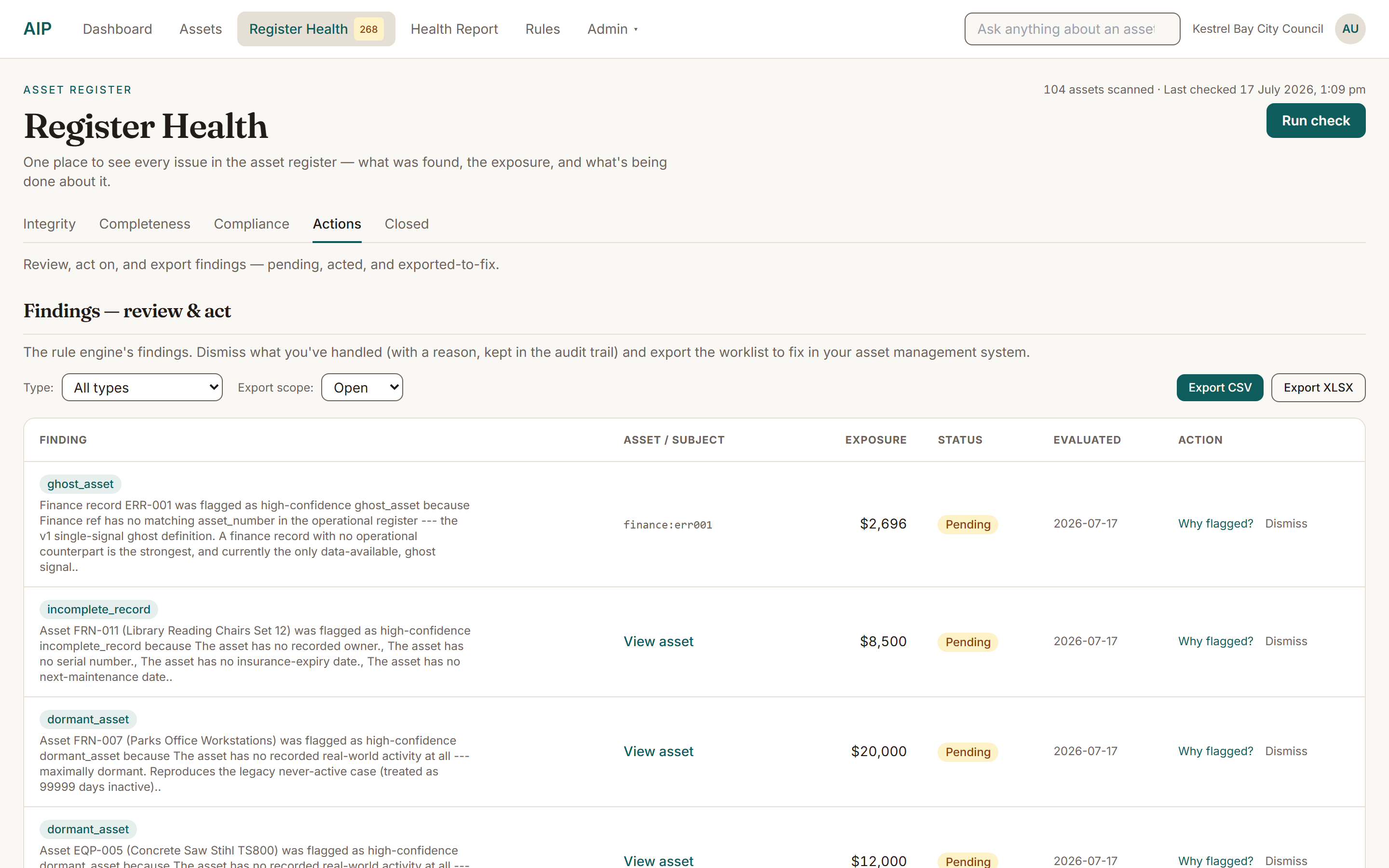
Register Health findings worklist showing ghost asset, incomplete record and dormant asset findings with dollar exposure, status and why-flagged links
Every finding with its evidence — work through them, dismiss with a reason, export the worklist, watch findings close when the data is fixed.

Screenshots show the live product on demonstration data for the fictional Kestrel Bay City Council.

Sample · Demonstration data

Asset Register Health Report

Kestrel Bay City Council · 2,400 assets · $403.6M

Register health: Needs attention

The real 20-page PDF a council receives — verdict, findings with evidence, dollar exposure, and a prioritised fix list. Built on demonstration data and labelled as such.

Sample report or a live demo — your call.

We'll reply to your work address. Your details are used once, for this — no lists, no follow-up sequence.

Official organisation address — personal email domains aren't accepted.

That looks like a personal email address. Please use your organisation address — it's how we verify requests.

Thanks — the sample report is on its way to your inbox. It comes from a real person, usually within one business day.
Something went wrong sending your request. Please email us directly at sales@aetherstride.com and we'll send the report by reply.

We only use these details to send the report and, if you ask, to arrange a conversation. Nothing is shared, sold or added to a mailing list.

Who it's for

Built for Australian local government first — the register structures, valuation cycles and audit obligations councils actually have. The same engine fits any organisation that carries a large physical asset register.

Local councils Water & energy utilities Universities & TAFEs Hospitals, health & aged care Transport & ports Any asset-heavy organisation

Why this exists

State audit offices keep finding the same thing: council asset registers that don't reflect reality — assets that were disposed of years ago, valuations long past their cycle, records too incomplete to support the financial statements built on them.

It isn't negligence. Registers drift because the data lives in four or five systems that never talk to each other, and no one has time to cross-check thousands of assets by hand.

We built the engine that does the cross-checking — and packaged the first step as a fixed diagnostic, so a council can see exactly where its register stands before committing to anything larger.

See it running, live.

A 30-minute walkthrough on realistic council data — the dashboard, the findings, the report. No slides.